
Login
Support Sailonline
If you haven't already - join the SAILONLINE YACHT CLUB!
Please also consider making a donation - all amounts are greatly appreciated!
Board
»
Technical Support
»
Gain or loss by using TWA
Please login to post a reply.
|
Posted by Rod  |
|
|
I have observed that, when I set up an exact course to a specific point using the TWA, and then compare it with a CC course to the same point, that the CC course is slightly faster when measured by the predictor line.
My tentative conclusion is that, while the CC course is faster in one part of the course, it is slower in the other part. As the distance traveled on a curved course (TWA) is greater than on the straight (CC) course, it is therefore faster to use the CC course to any point. Would anyone care to comment? Am I correct? --- Last Edited by Rod at 2011-05-29 14:43:59 --- If it breaks, it's not strong enough--if it doesn't, it's too heavy. |
|
|
Posted by Chappo  |
|
|
I have taken advantage of the speed difference of CC or TWA in different races and yachts. I am not an expert but I think the differences come from various factors such as the shape and position you are sailing on the polar, whether you are sailing into a heading or lifting wind change and whether you are going upwind or downwind. So even though the CC is a shorter course, that advantage can often be offset by the fact that the last part of the CC course is so much slower than the TWA course (when sailing upwind into a header, or at the start of a CC course into a freeing wind change, the CC course is much slower than the TWA course.
|
|
|
Posted by ShamrockPirate  |
|
|
Rod
As we have worked through these same ideas over the past months, I think the answer lies somewhere in the world of VMC (an as yet magical and confusing place for the Pirate!) Check out the excellent blog from 76T. I have read it 10+ times and am SLOWLY starting to get the concept. VMC Example See you kn Vancouver! SP ---------- edited to change url to link to fit inside column --- Last Edited by RainbowChaser at 2011-06-16 22:36:22 --- |
|
|
Posted by AGage  |
|
|
There is just no way to make such a generalisation. Sometimes CC will be best, sometimes TWA. Of course if you try a CC and TWA course and predictor shows same location in 6 hours, or whenever you are intersting in, then sure: sail the CC course - it is also often safer over a wx update, although you can often get to a much better location using a combination of both.
It also depends on what the TWA course is doing exacly AFTER the point of interst (ie end of predictor) - if a CC course will sail high, then this is not good and you should either use the twa, or set a dc to change you at that time. same thing if the TWA is going to lit you toward a mark - you need a very good reason to sail further off the rhumbline than is necessary - either land (the ultimate reason!) or more favourable winds - pressure or a shift. As earlier stated, TWA is useful when sailing either upwind or downwind VMG in a persistent shift. The few times we get oscilaating shift in SOL it is not so simple - it depends on the magnitude of the shift. Those times you see top SOLers follow a gentle curving path - they are usually NOT sailing on a twa - but sitting at their computer for 14 hours changing course by .25 of a degree every 20 minutes, or setup a heap of DCs to do it for them - and yes they do spend that much time for the shorter races where every 0.05 of a nm counts! Just ask WINSTON  I help develop the client interface for the best online ocean racing sim there is... __/)/)_/)__ |
|
|
Posted by Chappo |
|
|
Good points Aaron, it is easy to work with confidence when plotting within 6 hour weather cycles, much more challenging after 6 hours so CC is a safe option. We have all seen some big shift between weather updates. I note you mentioned you have written a small tool that calculates both max VMG (for upwind & downwind) for a given TWS – , and also maximum VMC given input of TWS, TWD and a CC to the waypoint. Does it link to an uploaded polar or does it just require manual input based on different angles and BS from the polar at the time you choose to do a calc. Is that tool available for download somewhere? I use my simple worksheet attached for my max VMC calcs. I find it pretty good downwind, can be misleading upwind.
|
|
|
Posted by 76Trombones  |
|
|
I'll generalise
 (standard caveats apply) (standard caveats apply)
If we ignore difference in windspeed, we have two regimes: target inside tacking or gybe angles, target on a pure reach. Polar hop is same idea as up/downwind, but sideways. CC on reach. Straight line is shortest. The fast boats often sail a gentle curve if there is wind speed variation, but the gains are small. 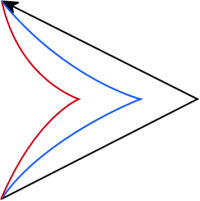
TWA (VMG) up/downwind unless you have a good reason to do otherwise. The red path above is TWA/VMG, blue VMC and Black CC. Both the TWA and CC tracks have a single steering input, while VMC adjusts continuously. TWA is usually faster and CC has to be very careful to not sail above VMG. If you're going to be paying that close attention might as well sail TWA? The huge bonus for sailing TWA is that the predictor tells you 90% of what you need to plan your strategy. If you're going to sleep, TWA might have you going backwards, while CC might have you stopped. I suppose it depends on how stable the weather is. CC is pretty conservative, but won't ever be fast vs the fleet (might beat TWA). TWA at least you have a chance of ending up somewhere good! |
|
|
Posted by Chappo |
|
|
Excellent summary 76. I presume it is not to scale but broadly highlights the distance differences. It certainly makes a good case for twa but as Aaron notes, just because the fast yachts have curved tracks, often actually reflects continuously adjusting VMC sailing rather than TWA sailing.
|
|
|
Posted by A2  |
|
|
--- Last Edited by 8mR Who at 2011-06-02 09:02:20 --- None so blind |
|
|
Posted by Chappo |
|
|
8MR, I see the diagram embedded in the post and as an attachment too?
|
|
|
Posted by A2 |
|
|
--- Last Edited by 8mR Who at 2011-06-02 09:00:44 --- None so blind |
Races
Next Race: 00d 00h 00m
Current Races:
ORCV Melbourne to Devonport Race 2026

Organized by the Ocean Racing Club of Victoria, this year’s battle against the unpredictable Southern Ocean features the stylish Dehler 46. Designed by Judel/Vrolijk as a proper looker and built to race, this regatta cruiser is a virtual flyer packed with modular racing upgrades. Can you master her speed and conquer the shifting elements?
Chart your course and race for glory in this historic adventure!
Race #2068
INFO by brainaid.de
Dehler 46 PARTICULARS
WX Updates:
0430 / 1030 / 1630 / 2230
Ranking: TQD - SUPBUD - SYC
Race starts: Oct 30th 03:30 Registration Open!
GO TO RACE
PIC Coastal Classic Yacht Race 2026

Expect the unexpected on this tricky course up the North Island's East Coast—from adrenaline-fueled spinnaker rides to nail-biting pre-dawn lulls. This year, we take on the elements in the highly popular Seacart 30. Designed by Marc Lombard, this nimble trimaran features a challenging polar that rewards pure tactical precision.
Chart your course, conquer the coastal currents, and race for ultimate bragging rights! Upon crossing the finish line in scenic Russell, the traditional reward of bacon butties and rum awaits!
Race #2067
INFO by brainaid.de
Seacart 30 PARTICULARS
WX Updates:
0430 / 1030 / 1630 / 2230
Ranking: SYC - SUPBUD - RED
RACE CLOSE: Wednesday,
October 28 at 2300 UTC.
Race starts: Oct 23rd 22:30 Registration Open!
GO TO RACE
Mad Max by Balloon 2026 - Across the Outback

Mad Max Rockatansky doesn’t get to go in a balloon in any of the Legends of the Wasteland, and the Wasteland is not necessarily the Outback of Australia, but Mel Gibson and film director George Miller indubitably are… of Australia, and ballooning as reconnaissance is a main feature of the Mad Max spin-off video game, so here goes: 1500nm in a balloon from somewhere on the edge of the Outback, Goondiwindi, to cross a finish line at Fitzroy Crossing, somewhere on the edge of the Outback!
Race #1974
INFOby brainaid.de
SOL Balloon PARTICULARS
WX Updates:
0430 / 1030 / 1630 / 2230
Ranking: BOL - SYC
Race starts: Oct 14th 13:00 Registration Closed
GO TO RACE
Arctic Tern - Greenland to Antarctica 2026

INFO by brainaid.de
Maxi Trimaran PARTICULARS
WX Updates:
0430 / 1030 / 1630 / 2230 Ranking:
OCQ4 - OCCH - SYC - MIG
RACE CLOSE: Wednesday,
November 4 at 2300 UTC.
Race starts: Oct 05th 11:00 Registration Closed
GO TO RACE
SYC Ranking

Series
- SYC ranking
- 2026 TSI
- 2026 TRQ4
- 2026 TRQ3
- 2026 TRQ2
- 2026 TRQ1
- 2026 TRCH
- 2026 TQD
- 2026 SUPerBUDdy
- 2026 SSANZ
- 2026 SPQ4
- 2026 SPQ3
- 2026 SPQ2
- 2026 SPQ1
- 2026 SPCH
- 2026 SHE
- 2026 ROW
- 2026 RNW
- 2026 RNI
- 2026 RMI
- 2026 RED
- 2026 OCQ4
- 2026 OCQ3
- 2026 OCQ2
- 2026 OCQ1
- 2026 OCCH
- 2026 NIA
- 2026 MIG
- 2026 MED
- 2026 LOOR
- 2026 CCZ
- 2026 BOL
- 2026 B2B
- 2025 TS
- 2025 TRQ4
- 2025 TRQ3
- 2025 TRQ2
- 2025 TRQ1
- 2025 TRCH
- 2025 TD
- 2025 SuperSOLer
- 2025 SSANZ
- 2025 SPRCH
- 2025 SPQ4
- 2025 SPQ3
- 2025 SPQ2
- 2025 SPQ1
- 2025 SHE
- 2025 SBB
- 2025 RWW
- 2025 RMI
- 2025 RED
- 2025 OCQ4
- 2025 OCQ3
- 2025 OCQ2
- 2025 OCQ1
- 2025 OCCH
- 2025 NT
- 2025 LOOR
- 2025 DN
- 2025 B2B
- 2025 ARQ4
- 2025 ARQ3
- 2025 ARQ2
- 2025 ARQ1
- 2025 ARCH
- 2025 ABS
- 2024 TS
- 2024 TRQ4
- 2024 TRQ3
- 2024 TRQ2
- 2024 TRQ1
- 2024 TRCH
- 2024 TD
- 2024 SVF
- 2024 SUPerSOLer
- 2024 SSANZ
- 2024 SPRQ4
- 2024 SPRQ3
- 2024 SPRQ2
- 2024 SPRQ1
- 2024 SPRCH
- 2024 SHE
- 2024 RTW
- 2024 RMS
- 2024 OCQ4
- 2024 OCQ3
- 2024 OCQ2
- 2024 OCQ1
- 2024 OCCH
- 2024 LOOR
- 2024 HILAT
- 2024 GWT
- 2024 DN
- 2024 CRW
- 2024 B2B
- 2024 ARQ4
- 2024 ARQ3
- 2024 ARQ2
- 2024 ARQ1
- 2024 ARCH
- 2023 TS
- 2023 TRQ4
- 2023 TRQ3
- 2023 TRQ2
- 2023 TRQ1
- 2023 TRCH
- 2023 TD
- 2023 SVS
- 2023 SUPerSOLer
- 2023 SSANZ
- 2023 SPRQ4
- 2023 SPRQ3
- 2023 SPRQ2
- 2023 SPRQ1
- 2023 SPRCH
- 2023 SHE
- 2023 RTW
- 2023 RNI
- 2023 RMS
- 2023 PIC
- 2023 OCQ4
- 2023 OCQ3
- 2023 OCQ2
- 2023 OCQ1
- 2023 OCCH
- 2023 LOOR
- 2023 DN
- 2023 ARQ4
- 2023 ARQ3
- 2023 ARQ2
- 2023 ARQ1
- 2023 ARCH
- 2022 TRQ4
- 2022 TRQ3
- 2022 TRQ2
- 2022 TRQ1
- 2022 TRCH
- 2022 TD
- 2022 Tall Ships
- 2022 SUPerSOLer
- 2022 SSANZ
- 2022 SSA
- 2022 SPRQ4
- 2022 SPRQ3
- 2022 SPRQ2
- 2022 SPRQ1
- 2022 SPRCH
- 2022 SHE
- 2022 OCQ4
- 2022 OCQ3
- 2022 OCQ2
- 2022 OCQ1
- 2022 OCCH
- 2022 NTR
- 2022 LOOR
- 2022 CTR
- 2022 ARQ4
- 2022 ARQ3
- 2022 ARQ2
- 2022 ARQ1
- 2022 ARCH
- 2021 TRQ4
- 2021 TRQ3
- 2021 TRQ2
- 2021 TRQ1
- 2021 TRCH
- 2021 TD
- 2021 Tall Ships
- 2021 SYCQ4
- 2021 SYCQ3
- 2021 SYCQ2
- 2021 SYCQ1
- 2021 SYCCH
- 2021 SUPerSOLer
- 2021 SSANZ
- 2021 SPRQ4
- 2021 SPRQ3
- 2021 SPRQ2
- 2021 SPRQ1
- 2021 SPRCH
- 2021 Shetland
- 2021 PAC6
- 2021 OCQ4
- 2021 OCQ3
- 2021 OCQ2
- 2021 OCQ1
- 2021 OCCH
- 2021 ESRW
- 2020 TSE
- 2020 TSA
- 2020 TRQ4
- 2020 TRQ4
- 2020 TRQ3
- 2020 TRQ2
- 2020 TRQ1
- 2020 TRCH
- 2020 Tasman Double
- 2020 SYCQ4
- 2020 SYCQ3
- 2020 SYCQ2
- 2020 SYCQ1
- 2020 SYCCH
- 2020 SUPerSOLer
- 2020 SSANZ
- 2020 SRQ4
- 2020 SRQ3
- 2020 SRQ2
- 2020 SRQ1
- 2020 SPRCH
- 2020 Shetland
- 2020 RTW
- 2020 RNI
- 2020 Odyssey
- 2020 OCQ4
- 2020 OCQ3
- 2020 OCQ2
- 2020 OCQ1
- 2020 OCCH
- 2020 A3
- 2019 TRQ4
- 2019 TRQ3
- 2019 TRQ2
- 2019 TRQ1
- 2019 TRCH
- 2019 Tasman Double
- 2019 Tall Ships
- 2019 SYCQ4
- 2019 SYCQ3
- 2019 SYCQ2
- 2019 SYCQ1
- 2019 SYCCH
- 2019 SUPerSOLer
- 2019 SSANZ
- 2019 SRQ4
- 2019 SRQ3
- 2019 SRQ2
- 2019 SRQ1
- 2019 SPRCH
- 2019 Shetland
- 2019 Round New Zealand
- 2019 OCQ4
- 2019 OCQ3
- 2019 OCQ2
- 2019 OCQ1
- 2019 OCCH
- 2018 TRQ4
- 2018 TRQ3
- 2018 TRQ2
- 2018 TRQ1
- 2018 TRCH
- 2018 Tasman Double
- 2018 Tall Ships
- 2018 SUPSOL
- 2018 SSANZ Triple
- 2018 SRQ4
- 2018 SRQ3
- 2018 SRQ2
- 2018 SRQ1
- 2018 SPRCH
- 2018 Shetland
- 2018 Shackleton Challenge
- 2018 OCQ4
- 2018 OCQ3
- 2018 OCQ2
- 2018 OCQ1
- 2018 OCCH
- 2018 40CH
- 2017 TS RDV
- 2017 TRQ4
- 2017 TRQ3
- 2017 TRQ2
- 2017 TRQ1
- 2017 TRCH
- 2017 Tasman Double
- 2017 Tall Ships
- 2017 SWR
- 2017 SUPSOL
- 2017 SSANZ Triple
- 2017 SSANZ RNI
- 2017 SPRR3
- 2017 SPRR2
- 2017 SPRR1
- 2017 SPRCH
- 2017 Red Dot
- 2017 OCQ4
- 2017 OCQ3
- 2017 OCQ2
- 2017 OCQ1
- 2017 OCCH
- 2017 40CQ3&4
- 2017 40CQ1&2
- 2016 TRQ4
- 2016 TRQ3
- 2016 TRQ2
- 2016 TRQ1
- 2016 TRCH
- 2016 Tasman Double
- 2016 Tall Ships
- 2016 SUPSOL
- 2016 SSANZ Triple
- 2016 SRQ4
- 2016 SRQ3
- 2016 SRQ2
- 2016 SRQ1
- 2016 SPRCH
- 2016 RTWR
- 2016 OCQ4
- 2016 OCQ3
- 2016 OCQ2
- 2016 OCQ1
- 2016 OCCH
- 2016 Corporate Open Gold
- 2016 A3
- 2015 TRQ4
- 2015 TRQ3
- 2015 TRQ2
- 2015 TRQ1
- 2015 TRCH
- 2015 Tasman Double
- 2015 Tall Ships
- 2015 SYQ4
- 2015 SYQ3
- 2015 SYQ2
- 2015 SYQ1
- 2015 SYCCH
- 2015 SUPSOL
- 2015 SSANZ Triple
- 2015 SRQ4
- 2015 SRQ3
- 2015 SRQ2
- 2015 SRQ1
- 2015 SPRCH
- 2015 OCQ4
- 2015 OCQ3
- 2015 OCQ2
- 2015 OCQ1
- 2015 OCCH
- 2015 Aegean Rally
- 2014 Timed Races Championship
- 2014 Tasman Double
- 2014 Tall Ships
- 2014 SYC Championship
- 2014 SSANZ Trio
- 2014 SSANZ RNI
- 2014 Sprints Championship
- 2014 Scandinavian Tour
- 2014 Round The World Race
- 2014 Ocean Championship
- 2014-2015 Sailonline World Race
- 2013 Tall Ships
- 2013 SYC Championship
- 2013 SSANZ B&G Simrad
- 2013 Capt Anderson
- 2012 W Australia Regatta
- 2012 Tall Ships
- 2012 SSANZ B&G Simrad
- 2012 RNZ Two Handed
- 2012 Global Challenge
- 2012 Ecker Cup
- 2012 Black Sea
- 2012 A3
- 2011 Vancouver Island
- 2011 Tasman Double
- 2011 SSANZ B&G Simrad
- 2011 SOL Global Challenge
- 2011 SJORA Series
- 2011 Scandinavian Tour
- 2011 Round North Island
- 2011 Asian Sprints
- 2011-2012 SOL World Race
- 2010 Tasman Double
- 2010 Ouzo Rally
- 2010 Iberian Tour
- 2010 Auckland Regional
- 2009 French SOLo
- 2009 Bosphore - Bretagne
- 2008 SYCC
- 2008 -2013 SYC Week Race Championship
- 2008 -2013 SYC Week-End Race Championship
- 2008 -2013 SYC Ocean Race Championship
- 2008-2009 Sailonline Ocean Race
- 2004 LOOR
Mobile Client
SYC members have the benefit of access to our mobile/lightweight web client!